Why COI for Business Is Your First Step to Smarter High Ticket Sales Investments

Introduction: Why Understanding COI Is Your First Step to Smarter Investments
Picture this. You find a high-ticket closing training program that promises big earnings. The price tag looks reasonable. You are ready to sign up and dive in. But wait.
Have you stopped to think about the real cost of that decision?

Many people jump into training without understanding the true cost of investment or COI for business. They look at the dollar amount and nothing else. That is a mistake that can cost you thousands in lost income and wasted time.
Here is the thing. COI goes way beyond the sticker price. It includes the hours you spend learning instead of working. It covers the opportunities you say no to while you train. It even includes the risk that the program might not deliver what it promises.
When you look at the full picture, you start to see why smart professionals take their time. They do not just ask "How much does this cost?" They also ask "What will this cost me in the long run?"
Research shows that calculating the return on investment helps you see whether training actually improves performance or just drains your wallet. One study breaks down how to measure training ROI by comparing the increase in profit against the program cost. For example, if you spend $10,000 and see a $30,000 gain, your ROI is 300%. That sounds amazing until you realize that not all programs deliver those results.
The real cost includes indirect expenses too. Things like your time, your focus, and the money you could have earned elsewhere. According to accounting experts, the true cost of any business purchase includes both direct spending and indirect costs such as training time.
So before you commit to anything, take a step back. Look at the full COI for business. Think about your time, your energy, and your income potential. That one simple habit can save you from expensive mistakes.
If you are serious about building a career in high-ticket sales, start by learning the fundamentals first. Understanding the numbers now means you make smarter choices later. And smarter choices lead to bigger returns.
What Is COI in Business? A Clear Definition for Aspiring Closers
So what does COI actually mean for you as an aspiring high-ticket closer? Let us break it down in plain terms.
COI stands for Cost of Investment. In business, this metric measures the total amount you put into something before you see any return. Think of it as the full price tag for a decision. Not just the dollars you hand over, but every resource you spend to get a result.
For someone building a career in high-ticket sales, COI for business includes three main parts:
-
Monetary costs. This is the cash you pay for training, coaching, software, or tools. According to one industry report, quality sales training can range from $400 to $6,000 depending on the program and its features. Some programs cost even more when you factor in customization or support.
-
Time costs. Every hour you spend learning or practicing is an hour you are not closing deals and earning commissions. That time adds up fast. If a training program takes 40 hours of your week, you lose the income you could have made in those 40 hours.
-
Opportunity costs. This is the money you could have earned by choosing a different path. For example, if you pick a six-month coaching program instead of a one-month intensive course, you miss out on five months of potential commission income.
Here is the thing. Many beginners only look at the sticker price. They see a $2,000 course and think that is the cost. But the hidden costs of sales training often include implementation time, ongoing practice, and even travel expenses if the training is in person. One analysis shows that travel alone can eat up 40% or more of the total investment for live events.
Understanding your COI for business helps you compare opportunities side by side. A program that costs $3,000 but gets you earning in two weeks might be a better deal than a $1,500 course that takes three months to deliver results. You can see why smart closers look at the full picture before committing.
If you want to start your journey the right way, check out this guide on how to start a high-ticket sales career in 2026. It walks you through the first steps without guessing.
Remember, your goal is to make investments that pay off. And that starts with knowing the real cost of every choice you make.
Why COI Matters for High-Ticket Closers: Avoiding Costly Mistakes
You now know what COI for business really means. But here is why it matters so much for you as a new high-ticket closer. Ignoring your COI is one of the fastest ways to lose money, time, and motivation.
Without a clear COI analysis, you risk spending thousands on training that does not match your situation. Maybe you buy a $3,000 course that focuses on in-person sales, but you want to work remote. Or you sign up for a six-month coaching program when a one-month intensive would get you to your first commission faster. The hidden costs of sales training add up quickly, and if you do not compare them, you are basically guessing.
COI also helps you set realistic income expectations. This is huge when you are starting out. The average high ticket closer salary in the US ranges from about $48,000 to $520,000, with many earning around $111,000 to $142,000 per year. But most closers work on commission, earning 10% to 20% of each sale. That means your first few months might be lean while you learn the ropes and build your pipeline. If you know your total COI for business, you can calculate exactly how many deals you need to close just to break even. That keeps discouragement away during that ramp-up period.
Remote sales professionals also face unique costs that must be part of your COI. Think about it. You need a home office setup, a good laptop, a CRM subscription, high-speed internet, maybe a second monitor, and software for managing leads.

These expenses add up fast. If you ignore them, your true investment is higher than you think. Your business profile as a closer should reflect all these tools and skills you bring to the table.
The bottom line is this. Every dollar and hour you invest should have a clear path to a return. By understanding your COI for business, you avoid costly mistakes and set yourself up for steady growth. If you want to build a strong foundation for your career, check out this guide on how to choose a direct sales agency for high-ticket sales. It helps you pick the right agency based on your real costs and goals.
Start with your COI, and you will make smarter moves from day one.
Breaking Down the Components of COI: Money, Time, and Opportunity
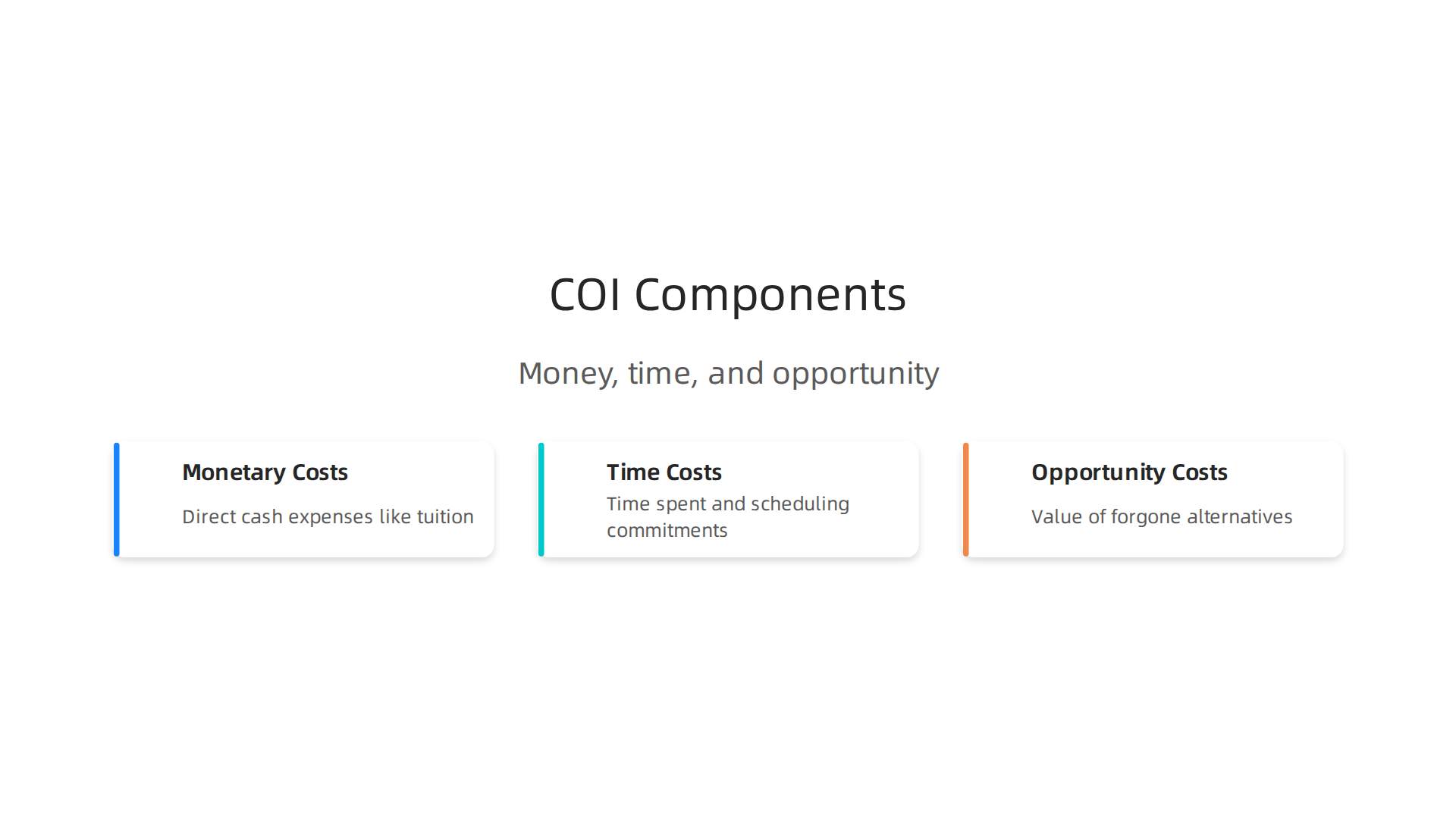
Now that you understand why COI for business matters, let us get specific. Your cost of investment is not just one number. It is actually three different types of costs working together.
If you miss even one, you will be guessing instead of planning.
Here is a simple breakdown of the three parts:
Monetary Costs: The Dollars You Spend
This is the easiest part to track. These are the real dollars leaving your bank account. For a high-ticket closer, monetary costs usually include:
- Tuition for training programs and courses
- Software subscriptions like a CRM system
- Dialer tools for making calls
- Lead generation tools to find prospects
- Marketing expenses like website hosting and ads
Think of it this way. If you sign up for a $2,000 training course and pay $150 each month for a CRM and dialer, that adds up fast. Do not forget the smaller costs either. Things like a good headset, a second monitor, and even internet upgrades all count toward your COI for business.
The good news is you can calculate your return on these costs. A simple ROI formula from the US Chamber of Commerce shows you how: divide your net profit by your total investment, then multiply by 100. Most sales training programs see between 25% and 300% ROI when done right.
Time Costs: The Hours You Invest
Here is the thing about time. You cannot get it back. And as a new closer, you will spend a lot of it before you see your first commission.
Time costs include:
- Hours spent learning sales scripts and objection handling

- Practice time doing role plays with peers or coaches
- Prospecting time reaching out to leads that may not buy
- Research time learning about products and industries
Most new closers spend 20 to 40 hours per week during their first few months. That is a serious time investment. When you calculate your COI for business, add up these hours and think about what they are worth. If you normally make $30 per hour at a part-time job, those 40 hours per week are worth $1,200 in lost wages alone.
Opportunity Costs: What You Give Up
This is the hidden one. Opportunity cost is the income you could have earned doing something else instead.
Maybe you could work a steady remote customer service job making $45,000 per year while you learn high-ticket sales. By choosing to focus fully on training and prospecting, you are giving up that income temporarily.
Your business profile as a closer should account for these opportunity costs. The Small Business Administration recommends factoring in what you sacrifice when making any business investment. If your total COI for business is $8,000 over three months, but you could have earned $15,000 at another job, you need to know that number before you commit.
Understanding all three costs gives you a clear picture. And that picture helps you choose the right training and tools from day one. If you want to compare options and see which path gives you the best return, check out this guide on how to choose a direct sales agency for high-ticket sales. It walks you through the exact factors to consider.
How to Calculate COI for High-Ticket Sales Training and Tools
Now that you know the three parts of your COI for business, let us put them together into a simple calculation. You do not need to be a math expert. You just need a clear formula to see if your investment makes sense.
The Simple COI Formula
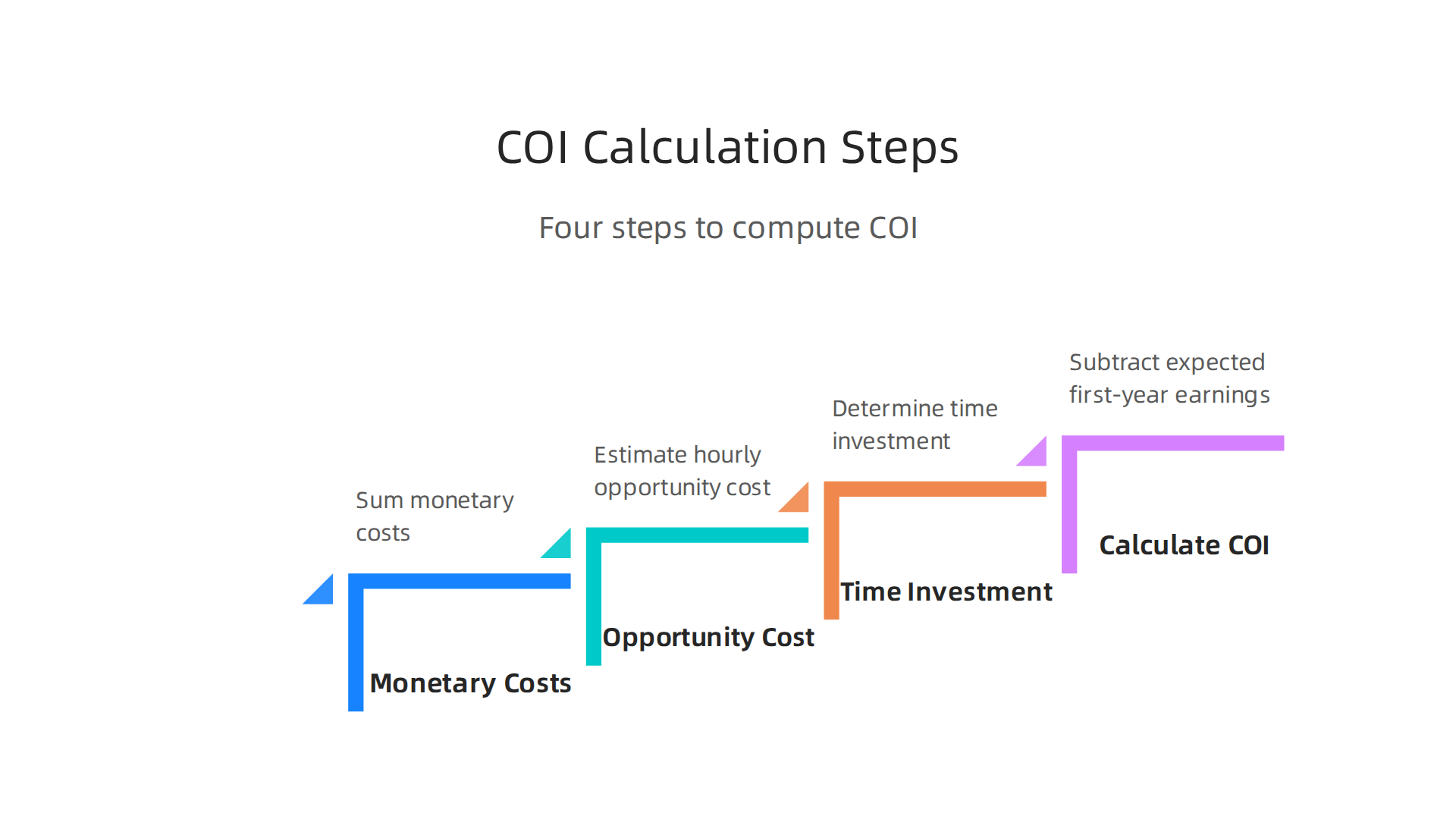
Here is the formula to use:
**COI = (All monetary costs + (Hourly opportunity cost × Time investment)) – Expected first-year earnings
**
Let me walk through each piece.
Step 1: Add up your monetary costs. This includes one-time costs like a $2,000 training course. It also includes recurring costs like software subscriptions. For example, a CRM at $50 per month and a dialer at $100 per month add up to $1,800 per year. If you sign up for a 12-month contract, build that into your total.
Step 2: Calculate your time costs. Multiply your hourly opportunity cost by the hours you will invest. Most new closers spend 20 to 40 hours per week during training. If your time is worth $30 per hour, that is $1,200 per week in value. Over three months of training, that is about $14,400.
Step 3: Estimate your expected first-year earnings. High-ticket sales involve premium deals, often $5,000 and up. According to Apollo.io, these deals have longer sales cycles and higher scrutiny on ROI. Your earnings may not come fast. Some closers only close 2 to 5 deals in their first six months. Be realistic here.
Step 4: Do the math. Let me give you a quick example. Say your monetary costs total $3,000. Your time costs are $14,400. That gives you $17,400 in total investment. Now subtract your expected first earnings. If you expect to earn $15,000 in your first year, your net COI for business is $2,400.
Run a Break-Even Analysis
Now use your COI to figure out how many sales you need. Divide your net COI by your average commission per sale. If your net COI is $2,400 and you earn $500 per sale, you need just 5 sales to break even.
Keep in mind that high-ticket sales cycles can stretch. Martal.ca notes that deals over $100,000 can take 6 to 12 months to close. Your break-even point might come later than you hope. That is okay. Knowing this upfront helps you plan your finances while you learn.
Why This Matters
When you calculate your COI for business honestly, you stop guessing. You know exactly what it will cost to get started. You can compare different training programs and tools more easily. For a complete roadmap, check out our guide on how to start a high-ticket sales career in 2026.
Do the math before you commit. It will save you stress and set you up for real success.
COI vs. ROI: Why You Need Both to Make Smart Decisions
You just learned how to calculate your COI for business. But COI is only half the picture. To make truly smart choices about training programs and tools, you also need to understand ROI.
ROI stands for return on investment. It measures how much money you get back compared to what you put in. While COI tells you the total cost of getting started, ROI tells you how profitable your investment might be.
Here is the risk: many sales training programs brag about high ROI. They say things like "clients earn 500% returns" or "our students make six figures fast." But they often hide the real COI. Maybe the program requires expensive add-ons. Maybe you need a premium CRM, a dialer, lead lists, or ongoing coaching that costs extra. Without counting those, the claimed ROI is misleading.
High-ticket sales involve premium deals of $5,000 and up. As Apollo.io points out, these deals come with "longer cycles, multiple decision-makers, and higher scrutiny on ROI." That means you should scrutinize your own investment too.
When you look at COI and ROI together, you get the full truth. The best scenario is a low COI combined with a high ROI. That means you can start with little money and still earn big. But even a high ROI can leave you in the red if the COI is exorbitant.
Imagine this example. A program promises a 300% ROI. That sounds amazing. You invest $5,000 and expect $15,000 back. But if your actual COI is $20,000 after software, time, and lead costs, your net result is negative $5,000. The ROI number was true, but it did not matter because the cost to generate it was too high.
To avoid this trap, always calculate both metrics. Use a realistic business profile of your expected costs and earnings. If you are shopping for a program, ask about every possible cost. Compare programs by looking at their COI for business first, then their ROI claims. For help making a smart choice, read our guide on how to choose a direct sales agency for high-ticket sales.
Remember, a low COI with a decent ROI is often better than a high ROI with a hidden high COI. Do not let flashy numbers fool you. Use both measures to stay in control.
Real-World Examples of COI in High-Ticket Sales
Let’s put the COI for business formula into action. These two stories show why careful math matters more than big promises.
Case 1: The Smart Beginner
A new closer invested $2,000 in a training program. She also spent three months studying part-time while keeping her day job. That time was worth an opportunity cost of $4,500. Her total COI came to $6,500.
In her first year, she earned $12,000 from high-ticket sales. That gave her a net positive result of $5,500. Her investment paid off because she counted the full cost before jumping in. As experts at Train & Develop explain, knowing your real training costs helps you measure success clearly.
Case 2: The Costly Mistake
A career switcher enrolled in an advanced $5,000 program. He quit his job and studied full-time for six months. He forgot to count the opportunity cost of lost wages — about $18,000 ($3,000 per month). His true COI reached $23,000.
In his first year, he earned only $10,000. That left him with a net loss of $13,000. The program looked great on paper, but the hidden costs crushed his bottom line. According to Indeed’s guide on training ROI, you must include indirect costs like time away from work to get an accurate picture.
Comparison Table: How COI Changes Outcomes
| Scenario | Total COI | First-Year Earnings | Net Result |
|---|---|---|---|
| Smart beginner | $6,500 | $12,000 | +$5,500 |
| Career switcher | $23,000 | $10,000 | –$13,000 |
The difference? One person calculated their complete cost of investment. The other ignored opportunity cost. If you are new to this field, learn from these examples. A low COI can leave you ahead even with a moderate ROI.
For a deeper look at starting on the right foot, check out this guide on how to start a high-ticket sales career in 2026. It can help you avoid the hidden costs that trip up so many beginners.
Common COI Mistakes and How to Avoid Them
You now know how COI can make or break your high-ticket sales journey. But even smart people slip up. Here are the three most common mistakes with COI for business and how to sidestep them.
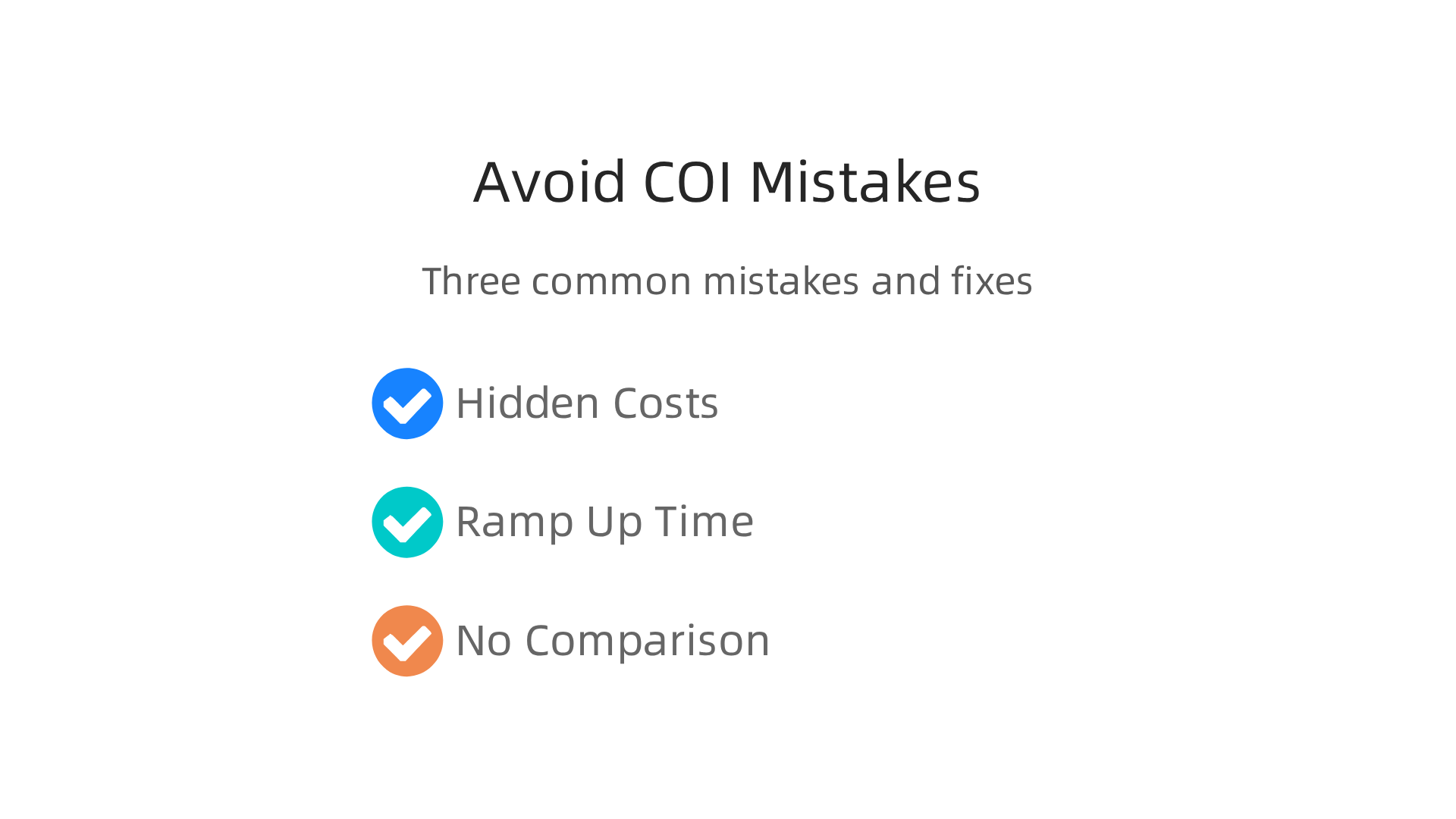
Mistake 1: Ignoring Hidden Costs
The sticker price of a program is only the beginning. Many sales courses add mandatory mentoring fees, upsells for advanced modules, and required tools like CRM software or dialers. According to Hyperbound, the true cost of sales training includes direct fees, opportunity costs, and ongoing reinforcement costs. Quality training can range from $400 to $6,000, but that number doesn’t include extras like travel or software subscriptions. For in-person training, travel alone can eat up 40% or more of your budget, as The Brevet Group notes.
How to avoid it: Before you sign up, ask for a full list of required and optional costs. Build a realistic business profile of what you’ll actually pay. If you run your own sales operation, using tools like Business Central can help you track every expense from day one.
Mistake 2: Underestimating Time to First Commission
Programs often sell the dream of fast money, but reality is different. Beginners commonly spend three to six months learning, prospecting, and closing their first deal. That time has a cost: lost wages from your current job or side income. Many people forget to count this opportunity cost in their COI.
How to avoid it: Add a "ramp-up time" column to your COI spreadsheet. Calculate how many months you expect to earn nothing or very little. Then multiply that by the income you’re giving up. For a realistic timeline, read our guide on how to start a high-ticket sales career in 2026. It covers the typical earning arc for beginners.
Mistake 3: Failing to Compare COI Across Programs
Emotion drives many buying decisions. A slick sales page makes you feel like you have to join that program right now. But when you don’t compare COI across multiple options, you often pick the most expensive one with the worst payoff.
How to avoid it: Create a simple table. List three to five programs. For each one, estimate the total COI: course fee, mentoring, tools, opportunity cost during training, and time to first commission. Then compare them side by side. The Small Business Administration offers free tools to help you plan budgets and evaluate investments. Use those same principles here. When you have numbers in front of you, the emotional pull fades.
Remember, the goal is a low COI that leaves you room for profit. Take the time to calculate correctly from the start. It’s the difference between a smart investment and an expensive lesson.
Actionable Steps to Evaluate COI Before Committing to a Program
You’ve seen the common mistakes. Now let’s turn that knowledge into action. Here are three practical steps to calculate your true COI for business before you hand over any money.
Step 1: List All Potential Costs
Grab a blank sheet or a spreadsheet. Start with the obvious: course fee, mentoring fees, and any required tools or software.

Then add the hidden ones. Think about your time. How many hours will you spend in training each week? How many hours prospecting? What is that time worth if you could be working a job right now?
Also add opportunity costs. If you leave a part-time gig to focus on sales, that lost income counts. Build a full business profile that includes every dollar and every hour you will invest. Using a tool like Business Central to track these expenses from day one can save you from nasty surprises later.
Step 2: Estimate Realistic First Year Earnings
This is where you ditch the guru promises and look at real data. According to Comparably, high ticket closers in the US earn between $48,230 and $520,049, with an average of $111,466. Glassdoor puts the average closer salary at around $142,002 per year. Most closers earn 10% to 20% commission on deals, as DialACloser explains.
But those are averages for experienced people. As a beginner, expect lower numbers during your first six months. Be honest with yourself about what you can realistically earn in year one. If a program promises you $200,000 in your first year with no experience, that is a red flag.
Step 3: Calculate Break Even and Assess Your Risk
Now the simple math. Divide your total COI by your expected monthly earnings. That tells you how many months until you break even.
For example, if your COI is $15,000 and you expect to earn $5,000 per month by month four, you break even in three months. If that timeline feels too long or risky for your situation, the investment may not be right for you.
The Small Business Administration offers free budgeting tools that work perfectly for this kind of calculation. Use them to see if the COI fits your personal risk tolerance and timeline.
If you want to see how different programs compare against each other, our guide on how to choose a direct sales agency for high ticket sales walks you through the exact comparison process.
Summary
This article explains the Cost of Investment (COI) for people entering high-ticket sales and shows how looking beyond the sticker price prevents costly mistakes. It defines COI as the sum of monetary costs, time costs, and opportunity costs, and provides concrete examples and a simple formula to calculate your true investment. You’ll learn how to estimate training and tool expenses, value your time during ramp-up, and subtract expected first-year earnings to get a net COI. The guide also explains why COI must be paired with ROI to judge profitability, walks through real success and failure case studies, and lists common errors new closers make. Actionable steps and a break-even method help you compare programs, set realistic expectations, and choose investments that actually pay off. By using these methods, you can plan finances, reduce risk, and pick training or agencies that match your goals.
Keep learning about closing and income