Master High-Ticket Sales Training to Build Core Skills and Maximize Commissions

Have you seen what top earners in high ticket sales are making right now? The numbers are real. In 2026, sales commission rates vary by industry but can range from 5% to 20% per deal based on complexity and margins. SaaS companies, for example, average around 10% to 12%. That kind of earning potential has opened the door for remote sales careers like never before.
But here is the reality check.
Most people who jump into this world crash and burn. They chase the money without building the foundation first. They skip real sales training and try to close without knowing how to listen or qualify a lead properly. Without those core skills, consistent commissions are almost impossible.
Mastering the basics is the only reliable path to success. A great sales representative knows how to handle objections naturally. They build trust before they ever ask for the sale. Working with a skilled digital coach can speed up this process, but you still have to commit to the fundamentals.
This article gives you a research backed, experience tested roadmap. We will walk through the exact skills you need to build from the ground up.
Ready to stop guessing and start mastering the fundamentals of high ticket sales? Contact Us today and we will help you choose the right next step for building your career and maximizing your commissions.
High-Ticket vs. Low-Ticket Sales: Understanding the Landscape and Your Income Potential
Let’s break down the two main paths in this world: high-ticket sales and low-ticket sales.
Understanding the difference is the first step to picking the right road for you.
Low-ticket sales usually involve products or services under $500. Think of a subscription box, a basic software plan, or a low-cost course. You might sell a lot of them, but each deal pays a small commission. You need high volume to make good money.
High-ticket sales is a different game. Here, you sell products or services that cost $2,000, $10,000, or even $50,000 or more. Think of a high-end coaching program, a premium software suite for a business, or a consulting package. Each sale is bigger, and the process to close one is more involved.
| Feature | Low-Ticket Sales | High-Ticket Sales |
|---|---|---|
| Price per product | Under $500 | $2,000 to $50,000+ |
| Sales process | Fast, scripted, high volume | Consultative, relationship-based, low volume |
| Skill level needed | Basic | Advanced (objection handling, trust building) |
| Commission potential per deal | Low ($10 – $100) | High ($200 – $10,000+) |
| Income stability | Depends on volume | Depends on closing high value leads |
How commission structures work
In high-ticket sales, you usually earn a percentage of the deal. Sales commission rates vary by industry. According to Apollo.io, rates can range from 5% to 20% based on complexity and margins.
SaaS companies, for example, average around 10% to 12%. Sell a $10,000 software package at a 12% commission, and you just made $1,200 from one deal.
Some roles also offer residuals or recurring commissions. That means you get paid again when a client renews their subscription. Everstate reports that quota attainment and total earnings vary widely by sector. A newer sales representative might earn a base salary plus a smaller percentage, while an experienced closer can negotiate higher splits.
Realistic income ranges for 2026
A beginner might earn $40,000 to $60,000 in their first year while learning the ropes. An experienced closer can easily surpass $100,000, and top performers in certain niches earn $200,000 or more. The key is that high-ticket sales offers more schedule freedom because you work fewer, but more valuable, leads.
But you need to be realistic. High-ticket requires advanced skills. You need to handle objections, build deep trust, and understand your client’s world. That’s why investing in real sales training and working with a skilled digital coach can cut your learning curve in half. Knowing the difference between high-ticket and low-ticket sales helps you choose a path that fits your goals and your current skill level. For more on what this role actually looks like, read our guide on what is a high-ticket closer.
If you are serious about building a career with a high earning ceiling, high-ticket sales is worth your focus. Contact Us today and we will help you choose the right next step for building your career and maximizing your commissions.
Core Communication Skills: Active Listening, Questioning, and Value Framing
Now that you understand the income potential in high-ticket sales, let’s talk about what actually makes you close deals. It is not a fancy script or a pushy pitch. It is three core skills that work together: active listening, smart questioning, and value framing.
Active listening builds trust fast.
Most people think sales is about talking. The truth is, the best closers barely talk at all. They listen. Active listening means you focus completely on what the prospect says, then show them you heard it.

Real active listening techniques for sales help you build deeper trust and uncover real needs.
Try these three techniques on your next call:
- Paraphrasing. After the prospect shares a challenge, say it back in your own words. "So it sounds like your biggest worry is that your team is spending too much time on manual data entry." This shows you understand.
- Summarizing. At key points, pull together everything they have said. "Let me make sure I have this right. You need a solution that cuts costs, saves your team time, and works with your current software."
- Mirroring. Repeat the last few words they say with a slight upward tone. If they say, "We are worried about implementation time," you say, "Implementation time?" This encourages them to elaborate without interrupting their flow.
The benefits of active listening in sales include better customer satisfaction and stronger alignment between what you offer and what they actually need. It also sets you apart from low-level reps who just read scripts.
Powerful questioning uncovers the real problem.
Listening alone is not enough. You need to ask the right questions to dig deeper. This is where frameworks like SPIN help. SPIN stands for Situation, Problem, Implication, Need-payoff.
The key is using open-ended questions. Instead of "Do you have a budget?" ask "How do you decide where to invest your budget this quarter?" Open-ended questions make prospects talk about their world. That is where you find the pain points that motivate a purchase. Professional sales training programs focus heavily on this exact skill because it separates beginners from closers.
Closed-ended questions have their place too, but use them only to confirm details, not to lead a discovery conversation.
Value framing changes everything.
Here is where most sales reps get stuck. They list features. "Our software has a dashboard and automated reporting." The prospect does not care.
Instead, frame everything in terms of ROI and outcomes. Connect each feature to a result the prospect already told you they want. If they said they waste 10 hours a week on manual reports, say, "With automated reporting, you get those 10 hours back every week. That is 40 hours a month you can redirect to growing your business."
This is how you sell high-ticket products. You stop talking about what your product is and start talking about what it does for them. If you want to go deeper on this, check out our guide on how to start a high-ticket sales career in 2026 for more advanced techniques.
Ready to build these skills and start closing real deals? Contact Us and we will help you find the right training path for your goals.
Building Trust and Credibility: The Foundation of Every High-Ticket Close
You have sharpened your active listening and questioning skills. But here is the hard truth: none of that matters if the prospect does not trust you. High-ticket sales involve serious money. Buyers need to believe you know what you are talking about. They need to feel safe handing you their budget. Trust is earned before you ever talk price.

Social proof kills skepticism.
When a prospect is on the fence, they look for evidence that other people like them made the right choice. This is where testimonials, case studies, and authority signals come in. A short video of a happy client saying, "We saved $50,000 in six months," beats a hundred features you could list. Case studies work the same way. They show real problems, real solutions, and real results.
You can also use authority. Being associated with recognized brands, certifications, or industry leaders instantly boosts your credibility. If you have worked with well-known companies, mention it. If you have completed a respected sales training program, bring it up naturally. The goal is not to brag. It is to give the buyer a reason to trust you before you ask for their money.
Stories sell. Statistics support.
There is a tug-of-war between stories and statistics. Both are useful, but do it wrong and you sound like a robot. The trick is to lead with a story that creates emotion, then back it up with data. For example: "One client came to us losing 20 hours a week to manual reporting. By switching to our automation, they cut that to 2 hours. That saved them $40,000 a year." The story paints the picture. The statistic proves it.
Avoid just listing numbers. Humans connect through narrative. If you only throw percentages at a prospect, they will tune out. If you only tell a nice story without proof, they will doubt you. Use both.
Be real. Desperation is a deal killer.
Here is the part most new sales reps miss. Prospects can smell desperation from a mile away. If you sound like you need this deal to pay your rent, you lose all credibility. The best closers come from a place of abundance. They know they offer value. They are confident but not pushy. This is called congruence, meaning your words, tone, and body language all match.
If you feel nervous, work on your mindset first. Practice on lower-stakes calls. Build your confidence until you genuinely believe you can help the prospect. That authenticity translates into trust.
For more on building a professional image from the ground up, check out our guide on how to set up a business email for high-ticket sales success. It is a small step that makes a big difference in how prospects see you.
Ready to put these trust-building skills into action? Contact Us and let us help you find the right path toward landing your first big deal.
Structuring the Sales Conversation: From Discovery to Close
You have built trust. Now you need a structure for the call itself. High-ticket buyers expect you to lead the conversation. If you ramble, you lose them. If you push too hard, you scare them off. The sweet spot is a natural, consultative flow that moves through five stages: qualification, discovery, presentation, objection handling, and close.
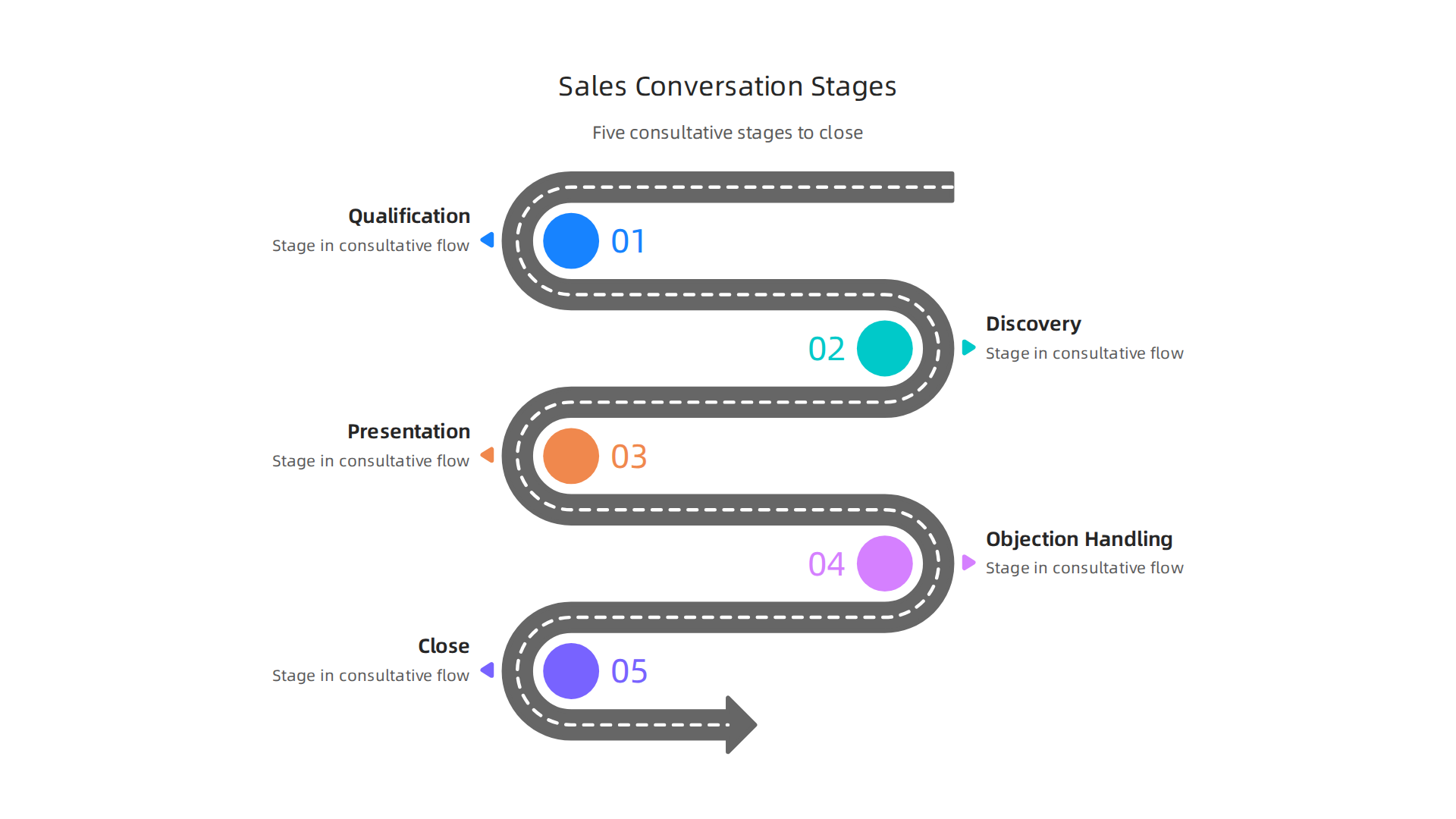
Stage one: qualification.
Do not waste time on people who cannot buy. Early in the call, ask direct questions about budget, authority, need, and timeline. If they do not have the budget or the decision-making power, you need to know before you invest an hour in a demo. Keep this stage polite but efficient. A good qualifier sets up everything that follows.
Stage two: discovery.
This is where you do most of your listening. Use the active listening skills you already practiced. Ask open-ended questions about their current situation, their pain points, and what they have tried before. Your goal is to uncover the real problem beneath the surface. The more you understand, the easier your presentation becomes.
Stage three: presentation.
Now you connect your solution to their specific pain. Do not just list features. Show how you solve the exact problem they described. Use the story plus data formula we covered earlier. Keep your presentation focused on them, not on your product.
Stage four: objection handling.
Objections are not rejections. They are buying signals. When a prospect says "It is too expensive," they are telling you they want to see the value more clearly. The best sales training programs teach you to pause before responding. That pause shows respect. It gives you time to think. Use frameworks like LAER or Feel-Felt-Found to address concerns without sounding defensive. The key is to validate their concern first, then reframe it. Expert tips on handling common objections can help you stay prepared for almost anything.
Stage five: close.
This is the natural result of a great conversation. If you did the first four stages well, the close is just a formality. Ask for the business directly. Use a simple question like "Does this make sense for you?" or "Are you ready to move forward?"
Transition naturally between stages.
Do not jump from qualification to close. Use transition phrases to guide the prospect. For example: "That makes total sense. Let me show you how we handle that." Or "I appreciate you sharing that. Here is how other clients solved the same problem." These small bridges keep the conversation smooth.
Avoid sounding scripted.
A consultative approach means you adapt to each prospect. Use the structure as a guide, not a rule. If they want to talk about pricing early, let them. You can circle back to discovery later. The best sales representatives know when to follow the flow and when to redirect.
Ready to put this structure into practice on your next call? Contact Us and we will help you build the skills to close more deals with confidence.
Objection Handling and Overcoming Resistance
You made it through qualification, discovery, and presentation. Now comes the part that scares most sales representatives: objections. Here is the truth you need to remember. Objections are not rejections. They are buying signals. When a prospect says "It costs too much," they are telling you they want your solution. They just need help seeing the value clearly. The best sales training programs teach you to welcome these moments.
Let us look at the most common objections in high-ticket sales. Price always comes up first. Then timing. Then trust. Then commitment. These four show up again and again according to research on thousands of real sales calls. When you know they are coming, you stop fearing them.
The ‘Feel, Felt, Found’ technique.
This classic framework works perfectly for high-ticket scenarios. Here is how it sounds in practice.
"I understand how you feel. Many of my clients felt the same way before they started. What they found was that the return on investment far exceeded the upfront cost."
The power is in the order. You validate their emotion first. Then you normalize it by showing others felt that way too. Then you share the outcome without pressure. This technique works because it never argues with the prospect. It invites them to see a new perspective.
For high-ticket sales specifically, you want to adapt this with real stories. Do not just say "other clients found value." Say "one client in your exact industry found that their revenue doubled within three months of implementing this system." Specificity builds trust.
Uncover the real objection.
Here is the secret most people miss. The first objection is rarely the real objection. When someone says "It is too expensive," they might really mean "I do not trust you yet" or "I am not sure this will work for me" or "I need to check with my partner."
You need layered questioning to get to the truth. Try questions like:
"That is fair. Help me understand what makes the price feel high compared to what you expected?"
"What would need to be true for this to feel like a smart investment for you?"
"If price were not an issue, would this be the right solution for your business?"
These questions peel back the surface layer. They help you and the prospect find the real block. The Highspot objection-handling playbook explains that uncovering the root concern is what separates top performers from average ones.
Pause before you respond. A short silence signals respect and gives you time to think. The prospect also fills that silence sometimes and tells you even more. Use frameworks like LAER or the empathetic reframing method to address concerns without sounding defensive.
Objection handling is a skill you build over time. Every call teaches you something new. If you want to take your skills further and learn from proven systems, check out our guide on what a high-ticket closer does and how to start your career in 2026.
Ready to master objection handling and close more deals with confidence? Contact Us and we will help you find the right path for your sales career.
Thriving in Remote Sales: Tools, Routines, and Self-Management
You have handled objections like a pro. But now you sit alone in your home office. No team around you. No water cooler chats. Remote high-ticket sales is freeing, but it can feel isolating if you do not set yourself up right. The good news is that with the right tools and habits, you can build a career that gives you freedom and high income without the burnout.
Essential tools that make remote sales work.
You do not need a dozen platforms. Just a few that cover your core needs. A good CRM keeps your leads organized and your follow-ups on time. Look for one that integrates with your email and calendar. Calendar management tools help you book calls without the back-and-forth. Tools like Calendly or Clara save hours each week.
Screen recording is a game changer for high-ticket sales. Record your demos or proposals so prospects can watch them again later. It builds trust and reduces the need for repeated calls. And do not forget payment processing. Have a reliable way to take deposits or full payments on the spot. The best sales productivity tools in 2026 focus on cutting out busywork so you can spend time on what matters: talking to people who want to buy.
Here is a quick list of tool categories you need:
- CRM to manage leads and deals
- Calendar booking to schedule calls effortlessly
- Screen recording to create personalized walkthroughs
- Payment processor to close fast
- AI assistant to handle email follow-ups and note-taking
AI tools are especially hot in 2026. They automate repetitive tasks like sending reminders or logging call notes. This frees you to focus on the human side of selling. Check out this roundup of 12 AI tools that actually improve sales productivity for ideas.
Daily routines that top remote closers follow.
Success in remote sales is not about working more hours. It is about working the right hours. High performers often start their day with deep work before any calls. They block out 90 minutes for prospecting or study. Then they take a short break to move their body. A walk, some stretching, or a quick workout resets their energy.
Call blocks are another secret. Group your calls together instead of spreading them all day. This keeps you in a sales mindset and prevents context switching. Many top closers do three two-hour call blocks each day. The rest of the time goes to admin, learning, and relationship building.
A digital coach or a structured sales training program can help you stay accountable. Many remote closers join mastermind groups or peer accountability pods. These communities give you feedback, encouragement, and a place to share wins and losses.
Overcoming isolation in remote sales.
You do not have to do this alone. Join online communities focused on high-ticket sales. Platforms like Slack or Discord host active groups where reps share deals, celebrate wins, and coach each other. Some groups even run weekly mastermind calls. Being part of a community keeps you motivated and sharp.
If you want to build a sustainable remote sales career, start by connecting with others who are on the same path. It makes the journey easier and more fun.
Ready to take your remote sales game to the next level? Contact us and we will help you find the right tools, training, and community support.
Continuous Skill Development: Training, Communities, and Staying Current
Your tools and routines are solid. But high-ticket sales moves fast. What worked six months ago might feel stale today. The best closers never stop learning. They treat their skills like a garden that needs regular watering. Let’s look at how you can keep growing.
How to pick the right sales training program.
The market is full of programs promising huge results. Some deliver. Others just take your money. Here is how to tell the difference.
Look for proven results from real students. A good program shows you actual outcomes from past participants. Not just testimonials with initials. Real names and real numbers. The best sales training programs in 2026 combine live coaching with practical frameworks you can use the same day.
Check the community. A transparent group where students share wins and losses is a healthy sign. You want a digital coach who engages with learners, not one who records a course and disappears.
Look at client outcomes. If a program claims to help people earn more, ask to see examples. Many top courses share case studies of how students grew their income after training.
The real value of practice.
Here is the thing. Watching a video or reading a script is not enough. You need to practice. Role-play groups are gold. They let you test new approaches in a safe space. You can stumble without losing a real deal.
Call analysis is another power move. Record your calls and listen back. What worked? Where did you stumble? A coach or peer can give you laser coaching on those specific moments. This kind of targeted feedback accelerates your growth faster than any course alone.
Stay current with what works now.
The sales world changes every year. New tools appear. Buyer behavior shifts. Top performers stay informed without drowning in information.
Here are resources worth your time:
- Podcasts from experienced closers who share real deal breakdowns
- Books focused on high-ticket sales psychology and negotiation
- Newsletters that curate the best sales insights weekly
- Events where you can network and learn from peers
A sales representative who stays current earns more. It is that simple. The difference between a beginner and a pro is often just a few hours of focused learning each week.
If you want a structured path, look at programs that offer ongoing support. A one-time course fades. A community with weekly calls and updated content keeps you sharp. Some of the best sales courses in 2026 are built around continuous access to mentors and peers.
Ready to find a training program that fits your goals? Contact us and we will help you choose the right next step for building a high-ticket sales career and maximizing commissions.
Summary
This article lays out a practical, research-backed roadmap to succeed in high-ticket sales by focusing on fundamentals rather than quick wins. It explains the difference between low-ticket and high-ticket selling, current commission structures (typically 5–20% with SaaS around 10–12%), and realistic 2026 income ranges for beginners and top performers. The guide breaks down the core communication skills—active listening, strategic questioning, and value framing—then shows how to build credibility with social proof and stories. You’ll get a clear five-stage call structure (qualification, discovery, presentation, objection handling, close), proven objection-handling techniques, and tips for thriving in remote roles with the right tools and routines. Finally, it covers how to choose effective sales training and stay current through practice, coaching, and community so you can reliably increase commissions and close higher-value deals.
Discover Valuable Insights and Strategies