How to Start a High-Ticket Sales Career in 2026

Beyond the Hype: Building a Real High-Ticket Sales Career
You see the promise everywhere online. The stories of six-figure months working from a laptop. The ads for instant "closer" status. It’s exciting, but it’s also incredibly noisy. For every genuine opportunity, there seem to be ten gurus selling a dream without a map.
This leaves many talented people stuck. They’re caught between information overload and the fear that the “high-ticket” world is all just smoke and mirrors. The truth is simpler and far more powerful. The opportunity is real, massive, and growing, but it belongs to prepared professionals, not overnight “gurus.”
Here’s the thing. The business-to-business (B2B) world is a multi-trillion-dollar engine. In the U.S. alone, B2B sales topped $15 trillion in 2025. Globally, the B2B ecommerce market is estimated at a staggering $36.16 trillion for 2026. This isn’t hype. It’s the economic landscape where real high-ticket sales happen, selling complex solutions like software, consulting, and industrial equipment.
This guide cuts through the noise. We’re moving past the fantasy of a quick fix and into the reality of building a valuable, high-income skill.

We’ll show you the tangible, high-value opportunity that exists right now in specific, growing niches. More importantly, we provide the structured, evidence-based path to get there.
Forget the confusion. Let’s build the clarity and confidence you need to succeed. This starts with understanding the real system, not just carrying a fancy coach business card case. It’s about what you know, not just what you hold.
Ready to see the real map? Let’s begin by exploring the foundational system you need to master in our complete high-ticket sales blueprint.
Understanding the 2026 High-Ticket Sales Landscape
So, what exactly does "high-ticket" mean today? It’s not just a fancy phrase. In 2026, a high-ticket sale typically refers to business-to-business (B2B) deals worth $10,000 to $100,000 or more. These aren’t impulse buys. They are considered investments in solutions like enterprise software, marketing agencies, specialized consulting, or industrial equipment.
The sales cycles are longer, often taking weeks or months. The stakes are higher for both the buyer and the seller. This is the arena where real income is built, far beyond the basics.
The Numbers Don’t Lie: A Massive Market
First, let’s talk about the opportunity. This isn’t speculation. The data shows a massive and growing market.
In the United States alone, B2B sales topped $15 trillion in 2025. On a global scale, the B2B ecommerce market is enormous, estimated to reach a staggering $36.16 trillion by 2026. Specific tech sectors are booming too, with the U.S. B2B tech reseller market forecast to grow another 3% in 2026.
This is the economic engine where high-ticket professionals operate. It’s real, it’s huge, and it’s waiting for skilled people.
The Shift: Remote and Relationship-Based
The way these sales happen has fundamentally changed. The old playbook of loud in-person pitches and flashy coach business card holders is outdated. The game is now remote, digital, and built on trust.

Buyers are smarter. They do their own research online long before they talk to a salesperson. A report on B2B buying behavior in 2026 highlights that most of the buying journey is now digital and self-directed.
This means your role has shifted from a presenter to a guide. You need new skills:
- Consultative Questioning: Uncovering deep business pains, not just listing features.
- Digital Communication: Building rapport and demonstrating value over video calls, email, and messaging.
- Trust-Building: Becoming a credible advisor before you ever discuss price.
It’s less about the sales items in your briefcase and more about the insights in your conversation.
Where the Opportunities Are Concentrated
High-ticket opportunities aren’t spread evenly. They cluster in industries where solutions are complex, valuable, and necessary for growth. Here are key verticals where demand is strong in 2026:
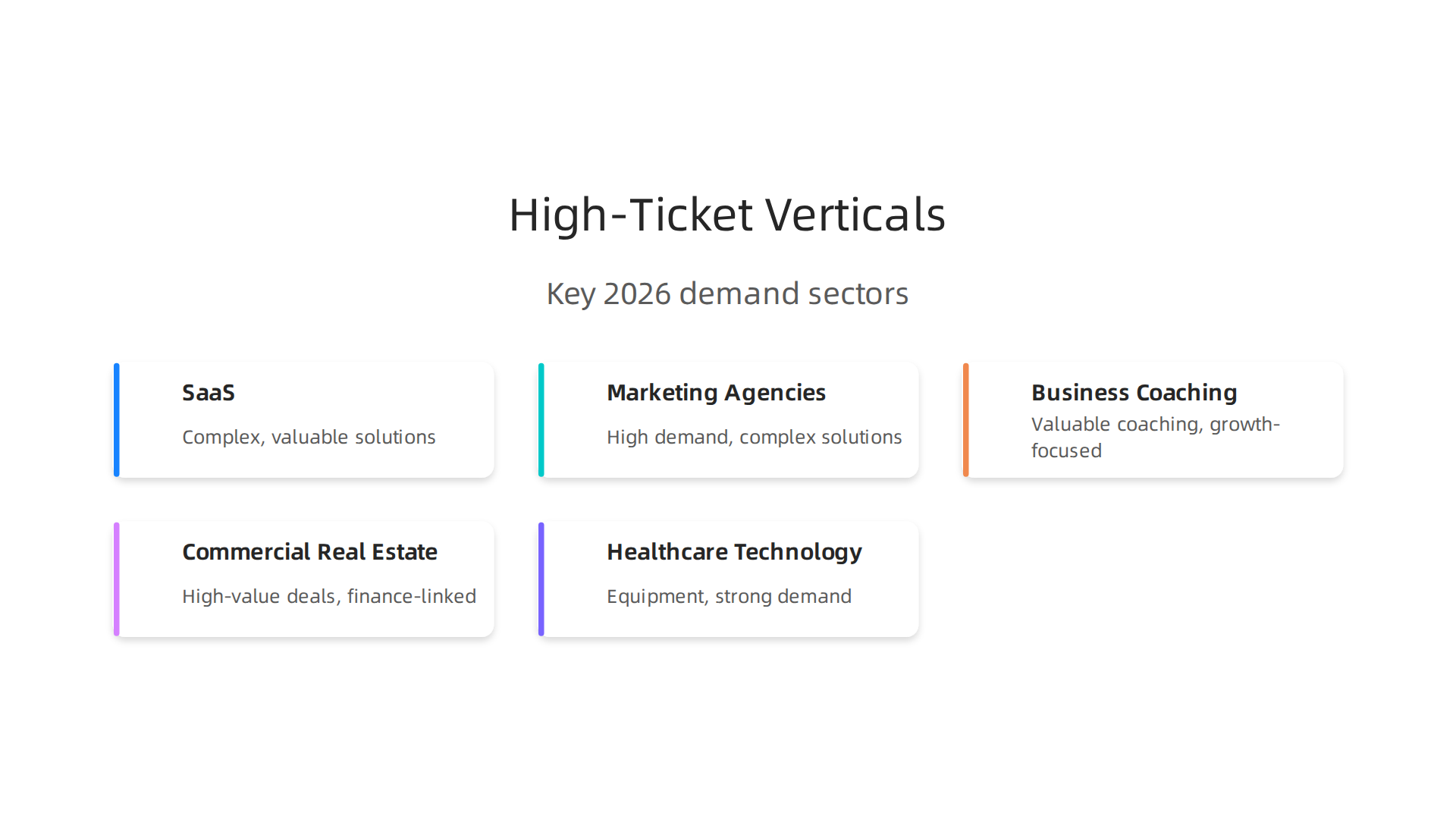
- SaaS (Software as a Service): Businesses constantly need new tools for efficiency, marketing, and data analysis. Selling these platforms is a core high-ticket field.
- Marketing & Advertising Agencies: Companies pay premium prices for expertise that drives revenue. Selling agency services involves long-term contracts and high value.
- Business Coaching & Consulting: This is a pure high-ticket service. You’re selling transformation and results, which commands fees of $20,000, $50,000, or more per client.
- Commercial Real Estate & Finance: These are classic high-ticket industries with long-established, high-commission structures.
- Healthcare Technology & Equipment: Selling advanced medical devices or hospital software systems involves complex, high-value deals.
The path is clear. The market is vast. Success now depends on mastering a modern system of value-based, remote selling. To move from understanding the landscape to building your place in it, you need a complete blueprint. Explore the proven methodology in our master guide to high-ticket sales.
Mapping Your Entry Path: From Beginner to Closer
You know the opportunity is huge. You see the shift to remote, value-based selling. The next question is the most practical one: "How do I actually get in?"
Your starting point doesn’t matter as much as your first step. Whether you’re a total beginner, switching careers, or a sales pro looking to level up, there’s a clear route for you. Forget the old image of a salesperson with a fancy coach business card case; your entry is digital, and your strategy is key.
Let’s map your path.
Choose Your Starting Lane
There are three main entry points into high-ticket sales in 2026. Pick the one that fits you.
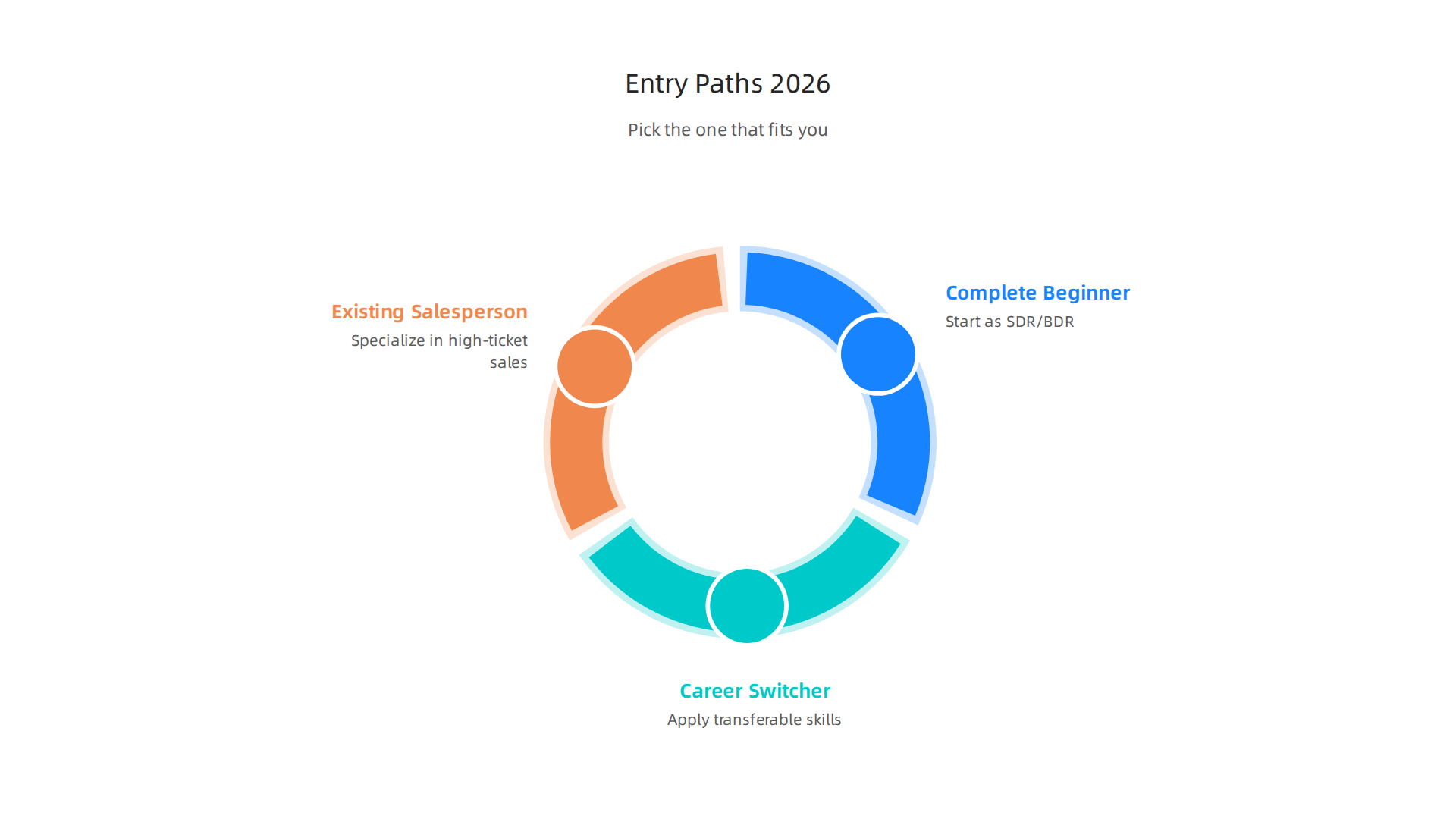
1. The Complete Beginner
You have little to no direct sales experience. Your advantage is a clean slate with no bad habits. The proven entry role is the Sales Development Representative (SDR) or Business Development Representative (BDR). Your job is to book meetings for senior closers. It’s a training ground where you learn prospecting, communication, and resilience. Sites like Indeed list many "High Ticket Sales No Experience" roles, often for SDR positions. This is your foot in the door.
2. The Career Switcher
You have experience in another field like teaching, project management, or customer service. This is a strength. You bring transferable skills like empathy, organization, and problem-solving. Your path involves repackaging your experience. Instead of just applying online, network strategically. As one guide notes, connecting with experienced professionals on platforms like LinkedIn often opens doors that applications cannot. Frame your past work as evidence you can understand client needs and manage complex processes.
3. The Existing Salesperson
You’re in sales, but maybe it’s low-ticket, retail, or a transactional role. You know the basics but need to upgrade your game. Your path is about specialization and mindset shift. You must move from presenting features to conducting deep discovery and guiding investments. Your first step is often a lateral move to a company with a high-ticket product, aiming for a closing role.
Your Critical First 90 Days: What To Do
Once you know your lane, these three steps are non-negotiable for a strong start.
Step 1: Ruthless Skill Assessment
Be honest with yourself. What can you do well? Maybe you’re a great listener or a persuasive writer. What are your gaps? High-ticket sales requires discovery questioning, handling tough objections, and mastering remote demo technology. Resources like the comprehensive Ultimate Guide to Break into High Ticket Sales can help you audit the skills you need to learn or improve.
Step 2: Strategic Niche Selection
Don’t try to sell everything. Your early success depends on focusing. Pick an industry you’re genuinely curious about or have background in. Is it SaaS for small businesses? Marketing services for coaches? Align with a niche where you can learn the language and problems quickly. This focus makes your personal branding and outreach infinitely more effective.
Step 3: Build a Digital Presence (Your New Business Card)
Your LinkedIn profile and personal brand are your new coach business card holders. They hold your credibility, not cardboard.

Build a profile that speaks to your chosen niche. Share insights, comment on industry discussions, and showcase your learning journey. This isn’t about bragging. It’s about demonstrating your commitment and building know-like-trust before your first interview.
Pitfalls to Avoid in Your First 90 Days
Starting strong means avoiding common traps that derail newcomers.
- Pitfall 1: Spraying and Praying with Applications. Submitting hundreds of generic online applications is the slowest path. As advised by experts, a more effective method is to "stop applying and start prospecting." Target specific companies and reach out to hiring managers or team members with a personalized message.
- Pitfall 2: Chasing the Highest Base Salary. Entry-level high-ticket roles often have a lower base but high commission potential. Focusing only on the base pay can lead you to roles with poor commission structures or low-value products. Look for the best overall opportunity to learn and earn.
- Pitfall 3: Neglecting Active Learning. This isn’t a passive career. The biggest mistake is waiting for company training. Use your first months to devour information. Listen to sales calls, read case studies, and practice your pitch. Your proactive learning speed determines your success speed.
- Pitfall 4: Isolating Yourself. Remote work can be lonely. Don’t silo yourself. Engage with your team, ask questions, and seek a mentor. Building internal relationships is as crucial as building external client relationships.
Your entry into high-ticket sales is a deliberate project, not a lucky break. By choosing your lane, executing the first steps with focus, and steering clear of early mistakes, you build momentum that carries you to your first close and beyond. For a detailed, step-by-step system that covers everything from landing the role to mastering your first close, our master guide to high-ticket sales is your comprehensive blueprint.
Demystifying Income: Realistic Commission Structures & Earnings
Now you know how to get in. The next big question is, how does the money actually work?
You won’t find your potential earnings printed on a fancy coach business card case. Your income in high-ticket sales is dynamic, tied directly to your performance. Understanding the different commission models is your first step to getting paid what you’re worth.
Let’s break down how you get paid, what you can realistically earn, and how to spot a great plan.
Breaking Down the Common Compensation Models
High-ticket sales roles typically use one of these three pay structures. Each has pros and cons.
- Base Salary + Commission: This is the most common and stable model. You get a guaranteed base pay (often lower than a traditional salary) plus a percentage of every sale you close. For example, a $50,000 base plus 10% commission on sales.
- Draw Against Commission: Here, you receive a regular "draw," which is an advance on your future commissions. If your commissions for the month exceed your draw, you get the extra. If they don’t, you owe the difference (a "draw deficit") that gets paid back from future commissions. It offers regular cash flow but requires careful management.
- Commission-Only: No base salary. Your entire income is a percentage of your sales. This model offers the highest earning potential but also carries the most risk. It’s best suited for proven closers with a strong pipeline.
A key trend in 2026 is transparency. Top companies now give reps "real-time visibility into their commission earnings as they close deals," as highlighted in the latest Salesforce State of Sales Report. This means you shouldn’t be guessing about your paycheck.
Realistic Earnings: What to Expect
Your income depends on your role, experience, niche, and commission plan. Here’s a transparent look at the ranges.
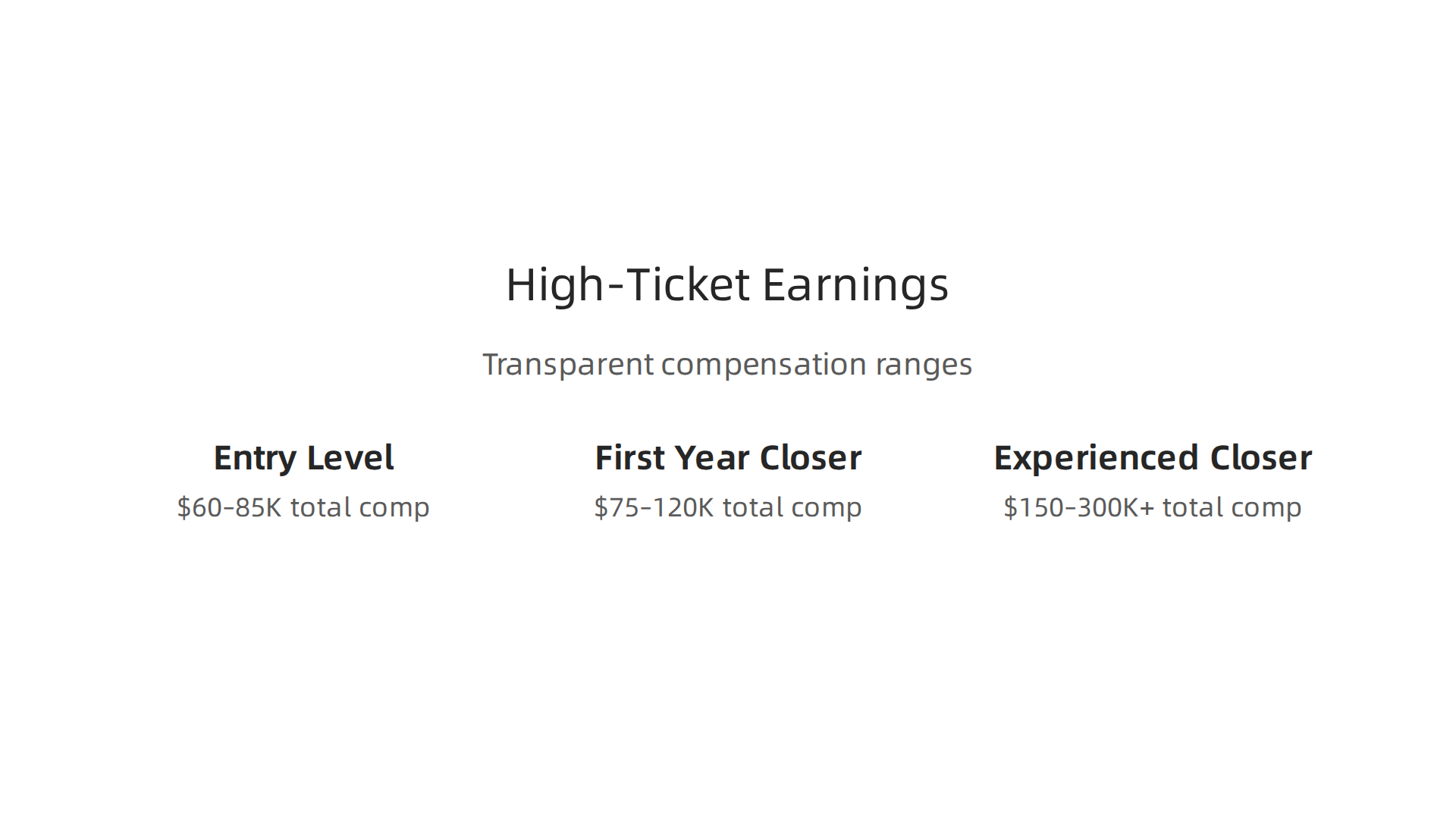
| Role & Experience Level | Realistic Total Compensation (Year 1) | Key Variables |
|---|---|---|
| Entry-Level (SDR/BDR) | $60,000 – $85,000 | Mix of base salary and bonus for booked meetings. Heavily dependent on activity metrics. |
| First-Year Closer | $75,000 – $120,000 | Lower base, higher commission. Earnings ramp up as you build pipeline and skill. |
| Experienced Closer (3+ years) | $150,000 – $300,000+ | Higher commission rates, bigger deal sizes, and often leadership bonuses. |
Remember, these are ranges. A closer selling $50,000 software deals will have a different trajectory than one selling $10,000 coaching packages. Your focus should be on the product’s value and your commission percentage.
How to Evaluate and Negotiate Your Commission Plan
Before you accept any offer, you must understand the plan. Don’t just look at the headline "earn up to" number. Ask these questions:
- What is the commission rate? Is it 5%, 10%, or 15% of the sale?
- What is it based on? Commission on the total deal value, net profit, or something else?
- Are there tiers or accelerators? Do you earn a higher percentage after hitting a quota? (e.g., 10% up to quota, 15% on everything beyond it).
- When is it paid? Monthly, quarterly, or when the client pays?
- What are the quotas and consequences? Is the quota realistic? What happens if you miss it?
When negotiating, frame it around your goal to deliver value. You might say, "I’m confident I can exceed the targets we’ve discussed. Would you be open to reviewing an accelerator clause after a successful first quarter?" This shows you’re focused on growth, not just a higher base.
Your earning potential in high-ticket sales is one of its biggest draws. By understanding the mechanics behind the paycheck, you can choose the right opportunity and build a strategy to maximize it. Think of it this way: your digital coach business card holders now showcase your skills, but your bank account will prove your results.
To dive deeper into advanced strategies for structuring your deals and maximizing every commission check, our comprehensive master guide to high-ticket sales provides the complete blueprint.
The Core Skill Stack for Modern High-Ticket Success
Now that you see the earning potential, let’s talk about the skills you need to actually reach it. In 2026, success isn’t just about a slick pitch. It’s about a balanced stack of fundamental, digital, and mental skills.
Think of it like this. Your physical coach business card case holds your identity. Your skill stack is what makes people remember you after the meeting is over.
The Three Foundational Sales Skills
Forget old-school pressure tactics. Modern high-ticket sales is a consultative process. Mastering these three core skills is non-negotiable.
- Deep Discovery: This is your most important tool. It’s the art of asking powerful questions to uncover a prospect’s real pain points, goals, and budget. You’re not just selling; you’re diagnosing. As one guide on becoming a high-ticket closer emphasizes, understanding buyer psychology is the first step to effective communication.
- Value Framing: Once you discover the need, you must connect your solution to it clearly. This means translating features into tangible outcomes and ROI for the client. Why is your $20,000 service the obvious choice? You frame it as the solution to their specific problem.
- Graceful Objection Handling: "It’s too expensive" or "I need to think about it" are not rejections. They are requests for more information. Your job is to listen, validate, and clarify. True objection handling, as noted in sales skills analyses for 2026, is about empathy and consultative problem-solving, not winning an argument.
Digital Fluency for Remote Selling
Most high-ticket sales in 2026 happen remotely. Your office is your laptop. You need to be proficient with the tools that make virtual selling effective and trustworthy.
- CRM Mastery: Your Customer Relationship Management (CRM) system, like Salesforce or HubSpot, is your brain. It’s where you track every interaction, set follow-ups, and manage your pipeline. Not using it well means losing deals.
- Video Communication: You must be compelling and clear on video calls. This includes your presence, your backdrop, and your ability to share your screen smoothly to present proposals.

- Async Communication: Much of the modern sales process happens over email, messaging apps (like Slack), and even video messages. You need to write clearly, follow up persistently but politely, and keep momentum going between live calls.
A guide on succeeding as a remote high-ticket closer points out that excelling requires more than basic sales knowledge; it demands comfort and skill with this entire digital toolkit.
The Mindset: Your Internal Operating System
Skills get you in the door. Mindset keeps you there for the long haul, especially when facing rejection or slow periods.
- Resilience: You will hear "no." Often. Top performers don’t take it personally. They learn from it and move to the next opportunity. This resilience is what separates those who burn out from those who build lasting careers.
- Continuous Learning: The best salespeople are always students. They listen to sales podcasts, review their own call recordings, and stay updated on new tools and techniques. In 2026, with AI changing the landscape, a commitment to learning is critical. Industry insights note that essential skills now combine AI fluency with deep relational empathy.
- Self-Management: When you work remotely, no one is looking over your shoulder. You must be disciplined with your time, proactive with your pipeline management, and organized with your tasks. Your productivity directly fuels your commission checks.
Building this complete skill stack takes deliberate practice. To see these skills in action and learn how to apply them in real sales conversations, from discovery to close, our master guide to high-ticket sales provides a complete framework. For a different perspective on mastering complex processes, you can also explore our insider’s guide to securing in-demand tickets, which highlights similar principles of preparation and strategy.
Your coach business card holders might be full, but your success is built on this powerful combination of human skill, digital savvy, and unwavering mindset. This is what turns potential into closed deals and commission into a thriving career.
Evaluating Training, Coaching, and Tools: A Buyer’s Guide
You have your skill stack mapped out. Now, the big question. With countless programs promising to turn you into a top closer, how do you choose wisely? Investing in the wrong training is like filling a premium coach business card case with flimsy, forgettable cards. It looks the part but doesn’t deliver results.
Let’s cut through the noise. Here is a straightforward buyer’s guide to help you invest in resources that actually build your high-ticket career.
Spotting Red Flags and Green Flags in Training
First, you must vet the trainer or coach. Your success depends on their real-world expertise, not just their marketing.
Red Flags to Run From:
- The "Guru" Who Never Sold: Be wary of trainers who can’t point to a verifiable track record of closing high-ticket deals themselves. As a credibility check notes, a key red flag is an inexperienced trainer who teaches theory without practice.
- Vague Promises: If their program guarantees specific income amounts or feels like a "get rich quick" scheme, it probably is. Real skill development takes time.
- No Clear Methodology: They teach scattered tips instead of a repeatable, structured process for discovery, framing, and closing.
- Poor Communication Skills: Ironically, some sales trainers are not great communicators. If their own sales reps seem unskilled, it signals a mismatch in training quality.
Green Flags to Look For:
- Transparent Track Record: They openly share case studies, client testimonials (with specifics), and their own background in sales.
- Focus on Fundamentals: Their program emphasizes the core skills we discussed, like deep discovery and value framing, not just closing tricks.
- Ongoing Support: The best training isn’t a one-time event. Look for programs that include coaching, community access, or follow-up sessions to ensure you implement what you learn. A common reason sales training fails is when it’s treated as a single event without reinforcement.
A Simple Framework for Measuring Your ROI
Before you spend a dollar, define what a return on that investment looks like. Move beyond vague goals like "get better at sales."
Ask yourself: What specific metric will this training improve? Experts in measuring training effectiveness stress that clear objectives are crucial. Here is a simple way to think about it.
- Define the Input (Cost): This is the total price of the course, plus the time you’ll invest.
- Define the Output (Gain): What is the tangible outcome? For example:
- "Close one additional $5,000 deal per quarter."
- "Reduce my sales cycle length by 10 days."
- "Increase my proposal-to-close ratio by 15%."
A good training program should help you draw a direct line from the lessons to these metrics. The impact can be measured in time saved, money earned, or clients gained. By framing it this way, a $2,000 course that helps you close one extra deal is instantly profitable.
Essential vs. Nice-to-Have Tools for a New Closer
You don’t need every shiny new sales tech tool. Start with the essentials that manage your process and communication. Think of these as the digital equivalent of your most reliable coach business card holders, keeping your pipeline organized and professional.
The Essential Toolkit:
- A CRM (Customer Relationship Manager): This is non-negotiable. It is the single source of truth for all your leads and conversations. Tools like HubSpot (with free tiers) or Salesforce are industry standards. Master this first.
- Video Communication Platform: Zoom, Google Meet, or Whereby. You need to be comfortable and professional on camera.
- Async Communication Apps: Slack for team communication (if you’re on a team) and a professional email client. Clear, persistent, and polite async follow-up is a core skill.
The "Nice-to-Have" (For Later):
- Advanced Prospecting Tools: Platforms like Apollo or LinkedIn Sales Navigator are powerful, but wait until you’ve mastered the fundamentals of outreach and have a consistent process.
- Call Recording/Coaching Software: Tools like Gong or MindStamp are fantastic for reviewing your calls and improving, but you can start by recording your Zoom calls (with permission) for self-review.
- Automated Sequence Tools: These can save time, but they should automate an already-effective personal outreach process, not replace it.
The goal is to build a foundation with tools that support your core skills, not overwhelm you. For a deep dive into applying these skills and tools within a complete sales framework, from the first conversation to the final handshake, our master guide to high-ticket sales provides that actionable blueprint. It’s the logical next step after choosing the right training.
Choose your training, coaching, and tools with the same discernment you use in your sales process. It’s the investment that turns the potential in your coach business card case into lasting, high-value relationships and commissions.
Building Your Network and Combating Remote Isolation
You’ve invested in sharp skills and smart tools. You’re ready to close. But there’s a hidden challenge in remote high-ticket sales that no tool can fix. Isolation.
Working from home can feel lonely. There’s no office banter, no quick tap on the shoulder to ask a question. For a closer, this isn’t just about missing people. It can drain your motivation and slow your growth. The good news? In 2026, building a powerful professional network and a supportive community is not only possible from your desk, it’s a strategic advantage. Think of it as filling your digital coach business card case with genuine connections, not just contacts.
Strategic Networking: Quality Over Quantity
Forget the old idea of collecting as many business cards as you can. Today’s effective networking is about targeted, valuable conversations. As networking experts point out, professionals seeing real results in 2026 focus on depth, not breadth. Stop trying to collect contacts and start building relationships.
Here’s where to focus your energy:
- Online Communities: Find niche communities related to your industry or sales methodology on platforms like LinkedIn or dedicated forums. Don’t just lurk. Ask thoughtful questions, share your wins (and lessons), and offer help to others. This is where you find your tribe.
- LinkedIn with Intention: Go beyond connecting. Comment meaningfully on posts from potential mentors or industry leaders. Share insights from your own sales experiences. A modern guide on effective networking strategies for sales executives emphasizes a step-by-step, intentional approach that builds real influence.
- Virtual Events and Workshops: Choose events that encourage interaction, like breakout rooms or workshops, not just webinars where you watch passively. Your goal is to have a few meaningful conversations, not to "meet" everyone.
Creating Your Peer Support System
Your network isn’t just for finding leads. It’s for building your own advisory board. This is your secret weapon against isolation.
Form a small mastermind or accountability group with 2-3 other closers at a similar level. This group becomes your lifeline for:
- Accountability: Share your weekly goals and check in on progress.
- Role-Play: Practice your discovery calls and handle objections together. This is some of the most valuable practice you can get.
- Sharing Insights: Discuss what’s working in your outreach, what tools you’re loving, and how you’re navigating tough negotiations. As remote selling evolves, sharing real remote selling strategies that work with peers keeps your playbook fresh.
Maintaining Motivation and Mental Fitness
Sales is a rollercoaster of highs and lows. Protecting your mindset is a non-negotiable skill for the long haul.
- Create Rituals: Start your day with a routine that signals "work mode," even if you’re just walking to your home office. End your day with a shutdown ritual to mentally clock out.
- Celebrate Small Wins: Closed a discovery call? Got a referral? Celebrate it. This builds positive momentum.
- Schedule "White Space": Block time in your calendar for thinking, learning, or just stepping away. Constant grinding leads to burnout. Remember, sustaining performance requires sales training strategies that include reinforcement and mental resilience, not just initial skill-building.
Building a robust career in high-ticket sales is about more than just the close. It’s about building the ecosystem that supports you. For a complete system that ties together your skills, your process, and your mindset, explore our master guide to high-ticket sales. It’s the blueprint for building a lasting and fulfilling career, one solid connection at a time.
Your 90-Day Launch Plan: Actionable Next Steps
You have your skills sharpened and your network growing. Now what? Moving from interest to income requires a clear map. Think of this 90-day plan as your guide to filling your coach business card case with real opportunities, not just dreams. Let’s break it down into simple, weekly actions.
Phase 1: Weeks 1-4 – Foundation and First Outreach
Your goal here is to shift from passive searching to active prospecting.
- Week 1-2: Research and Target. Don’t just browse job boards. Identify 10-15 companies you’d love to work for and find the hiring managers or sales leaders on LinkedIn. Make a simple spreadsheet with their names and roles.
- Week 3: Craft Your Story. Prepare a 30-second "why me" pitch. Focus on your transferable skills, hunger to learn, and understanding of high-ticket sales value. This isn’t a resume recap. It’s a conversation starter.
- Week 4: Make First Contact. Stop applying blindly. Start prospecting. As advised in a 2026 guide on breaking into competitive sales, the new way is to cold call or send a concise, personalized message to the hiring manager directly. Your goal is not a job application. It’s a request for a 15-minute informational interview.
Phase 2: Weeks 5-8 – The Conversation Phase
This is where you turn contacts into connections.
- Secure Informational Interviews. Use the outreach from Week 4. Your message should be respectful and curious. You’re not asking for a job. You’re asking for advice. Say you’re researching the high-ticket sales space and would value their perspective. Many professionals are willing to help.
- Prepare and Execute. Before each call, research the person and their company. Prepare 3-5 thoughtful questions. Listen more than you talk. Send a thank-you note afterward mentioning one specific insight they shared. This process of connecting with experienced professionals on platforms like LinkedIn often opens doors that formal applications cannot.
- Expand Your Circle. Ask every person you speak with for one introduction to someone else they think you should know. This is how you build a genuine web of contacts.
Phase 3: Weeks 9-12 – Demonstrating Value and Closing the Loop
Now you demonstrate you’re a serious candidate.
- Follow Up with Value. If you learned about a challenge in your conversations, send a relevant article or a brief idea a week later. This shows you listen and think proactively.
- Practice Publicly. Use insights from your interviews to write a short LinkedIn post about what you’re learning about high-ticket sales. Tag the people who helped you (with their permission). This builds your profile and shows engagement.
- Define Your Offer. Based on all your conversations, clarify what specific role or type of company you are targeting. Refine your pitch accordingly.
Tracking Progress: Beyond "Getting a Job"
Your success metrics for these 90 days should be activity-based, not just outcome-based.
- Weekly Targets: Aim for X number of new contacts added, Y number of outreach messages sent, and Z informational interviews completed.
- Skill Milestones: Complete a specific training module, record a practice sales call, or handle 10 new objections in role-play with your accountability group.
- Network Growth: Goal to add 50 quality connections to your LinkedIn network or to have spoken to 5 current high-ticket closers.
This plan turns a vague goal into daily action. For a deeper dive into the entire system, from mindset to mechanics, revisit our comprehensive master guide to high-ticket sales. Start today. Your first 90-day sprint begins now.
Summary
This article cuts through the hype around high‑ticket sales and gives a practical, step‑by‑step roadmap for building a sustainable, well‑paid career in B2B deals. It explains what "high‑ticket" means in 2026, where demand concentrates (SaaS, agencies, consulting, healthcare, real estate), and how the sales process has shifted to remote, relationship‑based work. You’ll get a clear entry map for beginners, career switchers, and existing salespeople, plus a concrete first‑90‑day plan to gain traction. The guide also demystifies compensation—common pay models, realistic earnings ranges, and negotiation questions—while listing the core skills, digital tools, and mindset required to succeed. Practical advice covers how to choose worthwhile training, avoid common pitfalls, and build a peer network to stay motivated. After reading, you’ll know how to pick a niche, plan your outreach, evaluate offers, and begin closing high‑value deals with consistency.
Keep learning about closing and income